The Citadel on Mount Pilgrim
A fortress raised to starve a city of scholars, a count who died in its shadow, and a name that outlived them all — the twelfth-century story behind the hill above Tripoli.
Specimen folio — replace me
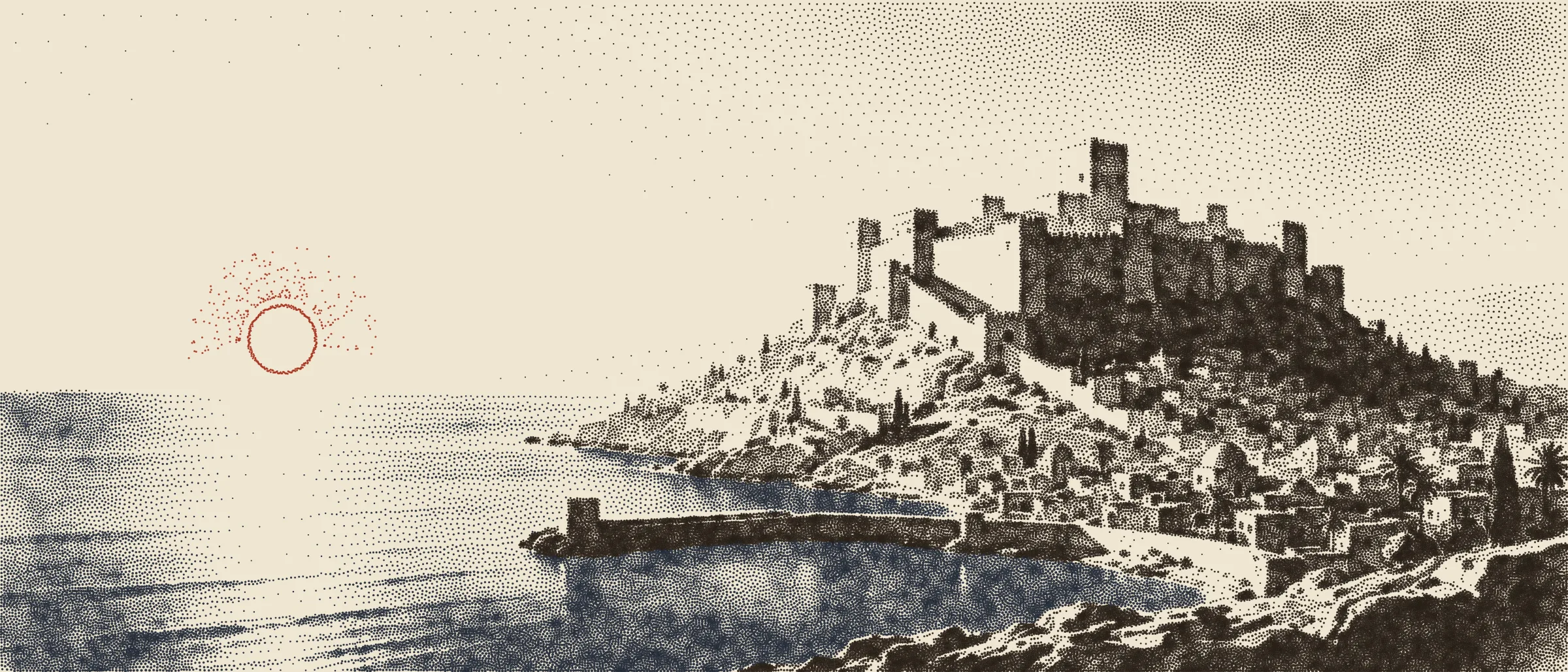
Every city has a hill it cannot stop looking at. In Tripoli it rises a little way inland from the old harbour, a spur of rock above the Abu Ali river, and on it stands the citadel that the city still calls, nine centuries on, by the name of the man whose fortress made it famous. The picture behind these pages is an attempt to see that hill as it may have looked around 1109, in the last season of a very long siege. It is an imagining, and this essay is partly an account of why it has to be.
Before the hill was a fortress, Tripoli was a port with an unusual reputation. From around 1070 the city was governed by the Banu ʿAmmar, a family of Shiʿi qadis — judges who had become, in effect, independent princes on the coast between the Fatimid and Seljuk worlds. Under them Tripoli grew rich on trade and became something rarer: a centre of learning. The family endowed a Dar al-ʿIlm, a “House of Knowledge”, where scholars were received, copyists employed and books gathered in quantities that later writers struggled to express without exaggeration.1
It is worth pausing on that image before the soldiers arrive. The traditional story of the Crusades on this coast is told from the camp outside the walls. But inside them, for most of those years, lived merchants, jurists, copyists and readers, under rulers who were still trying to buy time from larger powers, not least by diplomacy.
The count on the hill
Raymond of Saint-Gilles, count of Toulouse, was among the wealthiest and most stubborn leaders of the First Crusade. After Jerusalem fell in 1099 he was left without the principality his rank seemed to promise, and he turned north to the Lebanese coast. By around 1102–1103 he had settled down to take Tripoli, and since he could not storm a city that was supplied from the sea, he did the next best thing: he built a castle on the hill that commanded its landward approaches, and waited.2
The Franks called the hill Mons Peregrinus, Mount Pilgrim, and the fortress the castellum Montis Peregrini. It was less a siege engine than a rival town: a garrison, a base for raids, and a statement that the besiegers were not leaving. The people of Tripoli answered in kind. In 1104, chroniclers report, the defenders sallied out and set part of the castle ablaze. Raymond died there on 28 February 1105 — of injuries from that attack, in the usual telling, though the details vary from source to source. He never entered the city he had spent his last years besieging.3
The hill was taken first, and the city last; and between them lay seven summers of watching, each side counting the other’s ships.
— an epigraph written for this folio, attributed to no chronicle
The siege outlived its founder. Raymond’s kinsman William-Jordan took up the command, and the blockade tightened year by year. Tripoli’s last qadi, Fakhr al-Mulk ibn ʿAmmar, travelled to Baghdad in 1108 to seek help from the Seljuk sultan and came home empty-handed, only to find that the city had placed itself under a Fatimid governor in his absence. The end came in the summer of 1109, when Raymond’s son Bertrand arrived with a fleet — Genoese galleys prominent among it — and the princes of the Latin East gathered beneath the walls. Tripoli fell on 12 July 1109.4
What the name remembers
The conquest made Tripoli the capital of a new state, the County of Tripoli, ruled by Raymond’s descendants and their successors for most of the next two centuries, with Genoa taking a substantial share of the city as the price of its ships. It was a mixed society — Latin lords, Greek and Syriac Christians, Maronites in the mountains, Muslim and Jewish townspeople — and historians have lately taken it more seriously than the older narratives did, as a place with its own politics and its own culture rather than a footnote to Jerusalem.5
As for the library, the honest answer is that we do not know exactly what became of it. Later authors tell of its books being burned by the conquerors, and give figures that run from a hundred thousand volumes to several million; the numbers are certainly disputed and some are plainly impossible. Recent scholarship reads the evidence more cautiously and finds a quieter, sadder certainty: after 1109, Tripoli’s House of Knowledge simply disappears from the sources. Some of its books may have been destroyed, some ransomed, some carried away and scattered.6 A library can end in fire, or it can end by dispersal, one volume at a time. Either way, it ended.
The fortress on the hill, meanwhile, kept its founder’s name — in a language he never spoke. The Arabic-speaking townspeople did not call it Mount Pilgrim. They called it after the count himself: Qalʿat Ṣanjīl, قلعة صنجيل, the Castle of Saint-Gilles, the French place-name worn smooth in Arabic mouths into Ṣanjīl.7 It is still called that today. There is a particular irony, and a particular kind of justice, in a city remembering its besieger only as a sound.
The citadel that stands today
The County of Tripoli ended in 1289, when the Mamluk sultan Qalawun took the city on 26 April after a siege of about a month. The old harbour town was razed, and a new Tripoli was founded a few kilometres inland — at the foot of the pilgrim’s hill, beneath the castle. So the modern city, its souks and madrasas and hammams, grew up around the Crusader fortress rather than beside the sea it had once been built to cut off.
But the castle itself did not survive intact. It seems to have stood neglected for some years before a Mamluk governor rebuilt it around 1307–1308, reusing what he could of the earlier structure alongside ancient columns found nearby. Under the Ottomans it was restored again; an inscription over the great gate names Sultan Suleiman and dates the work to 927 of the Hijra, 1521 of the Christian era. Further rebuilding followed in the early nineteenth century. What a visitor climbs today is therefore mostly Mamluk and Ottoman work layered over earlier fragments; very little that can be confidently assigned to Raymond’s builders is visible above ground.8
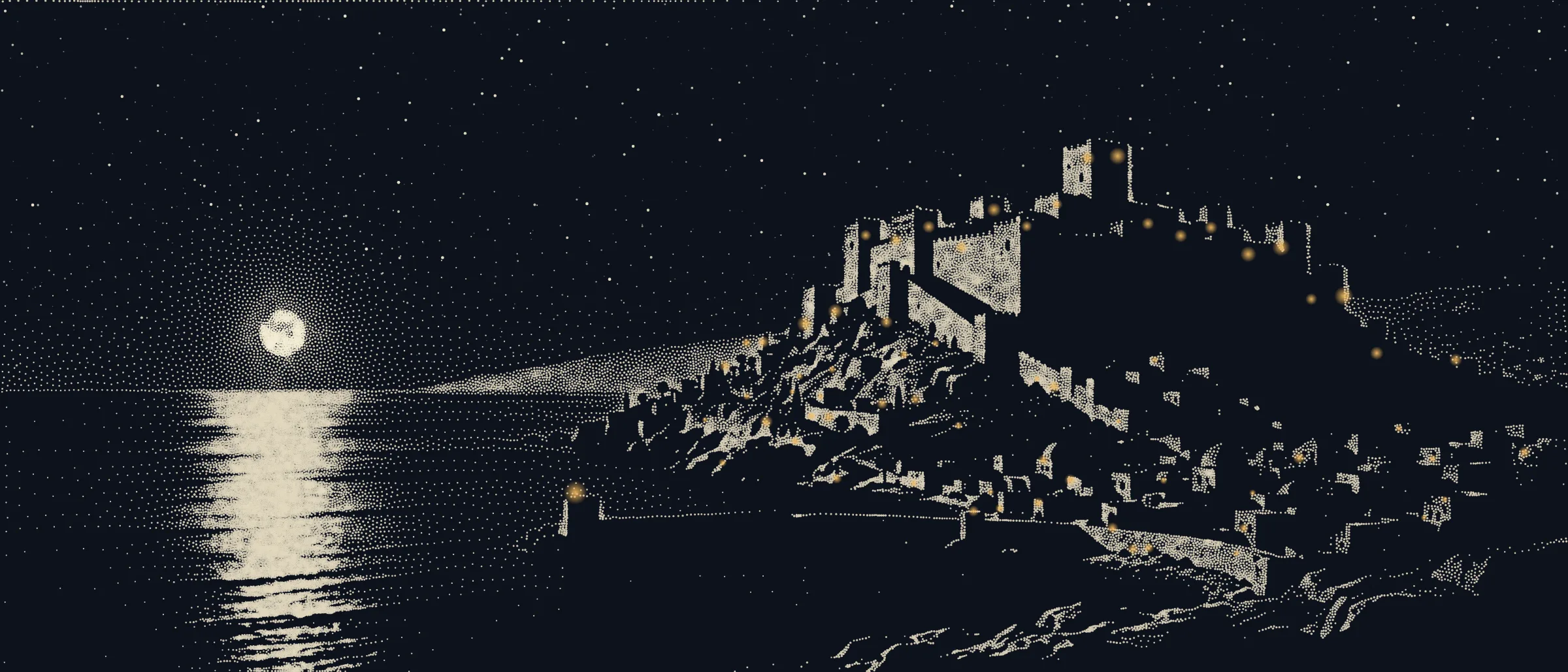
That is why the frontispiece of this codex is honest only as an interpretation. Its walls and towers are drawn from the shape of the hill and the habits of castle-builders of the period, not from a surviving plan; its harbour, its ships and its gulls are the scene a reader might imagine from the chronicles rather than one anyone recorded. The dots are ours. The hill, the sea, and the long argument between them are not.
Look at it, then, as the scribes of both sides might have: a fortress that was meant to end a city and instead became the centre of the next one; a library that vanished; and a name, Ṣanjīl, kept by the people it was built against.
Notes
-
The date at which the Banu ʿAmmar took power is given variously as c. 1065 or c. 1072, and the founding of the Dar al-ʿIlm is credited to different members of the family. Figures for its holdings range from 100,000 to over 3,000,000 volumes; none should be taken at face value. ↩
-
Accounts differ on whether the siege should be dated from 1102 or 1103, and on when work on the castle began. On the twelfth-century county, the standard studies are Jean Richard, Le comté de Tripoli sous la dynastie toulousaine (1102–1187) (Paris: Geuthner, 1945), and Kevin James Lewis, The Counts of Tripoli and Lebanon in the Twelfth Century: Sons of Saint-Gilles (Routledge, 2017). ↩
-
The date of 28 February 1105 is widely given; the manner of his injury and the interval before his death are told differently by different authors. ↩
-
Bertrand’s fleet included Genoese, Pisan and Provençal contingents; the size of the fleet is reported differently and should be treated with caution. Fakhr al-Mulk himself survived and later served the Seljuks. ↩
-
See Lewis, The Counts of Tripoli and Lebanon, which argues for the county’s distinctive character — including the Occitan poetry heard at its court. ↩
-
Konrad Hirschler, “Destroyed Books, Ransomed Books, Mobile Books: The Early Crusades and the Fate of Tripoli’s Library”, Al-Masāq 38, no. 1 (2026), 132–150. ↩
-
The name is also written قلعة سان جيل, Qalʿat Sān Jīl. Both forms render “Saint-Gilles”, the town in Provence from which Raymond took his name. ↩
-
For the architecture of Frankish fortification in the county and its neighbours, see Hugh Kennedy, Crusader Castles (Cambridge University Press, 1994). The Mamluk rebuilding is usually attributed to the governor Essendemir Kurji; the Ottoman inscription is dated Shaʿban 927 (July 1521). ↩